Ask a spray crew what they quoted last month and you will hear bed liners, a shop floor, maybe a tank. Balconies almost never come up. Which is strange, because balcony work has most of the things a coatings business says it wants.
Small square footage, excellent customers
A balcony is maybe forty to eighty square feet. On paper that is nothing. Price it by the square foot and you will lose money on the first one, because the material is the cheap part and the detail work is the job.
Price it by the balcony, though, and the picture changes. The buyer is rarely a homeowner with one deck. It is a property manager with forty identical units, a reserve fund, and a report sitting on the desk that names the problem in writing. The second building comes from the same phone call. So does the third.
Repeat work in this trade usually means chasing it. This kind finds you.
Why the phone is ringing now
California rewrote the rules after the 2015 Berkeley collapse, which killed six people and traced back to joists that had been quietly taking on water inside a closed-in balcony.
SB 721 now puts rental buildings of three or more units on a six year inspection cycle for balconies, decks, stairs and walkways more than six feet above grade that depend on wood for support. An inspector has to look at a minimum of fifteen percent of each type. Owners get 120 days to fix what gets found. SB 326 does the same thing for condo associations on a nine year cycle, with a licensed architect or structural engineer doing the inspection and a statistical sample rather than a flat percentage.
Those inspectors are not coating salesmen. They cut openings, look at framing and connections, and write down what they see. When the waterproofing has failed at the sill or the wall line, it lands in the report, and the owner is then on a clock.
Other states are not sitting still either. A number of cities have adopted their own facade and balcony ordinances, usually after a local incident. It is worth a call to your building department before you assume this is only a California story.
What makes a balcony bid different
Three things, mostly.
Slope. A quarter inch of fall per foot is the target, and plenty of older balconies do not have it. Correcting that with a bonded, sloped topping is its own line item, and it has to happen before anybody sprays. Coatings do not move water uphill.
The door. Build-up at the threshold eats sill clearance. Measure from the deck to the top of the sill before you quote a system, because a mortar bed and tile can swallow an inch and a half of it. A slider that will not close is a callback you cannot coat your way out of.
Access. Third floor, no elevator, hose run straight up the outside of the building. This is where a lot of crews decide the job is not worth it. It is also why small-footprint and cartridge-dispensed systems have quietly taken over a slice of this market, and why overspray control near windows and parked cars belongs in the bid rather than in the apology.
The margin is in the details, literally
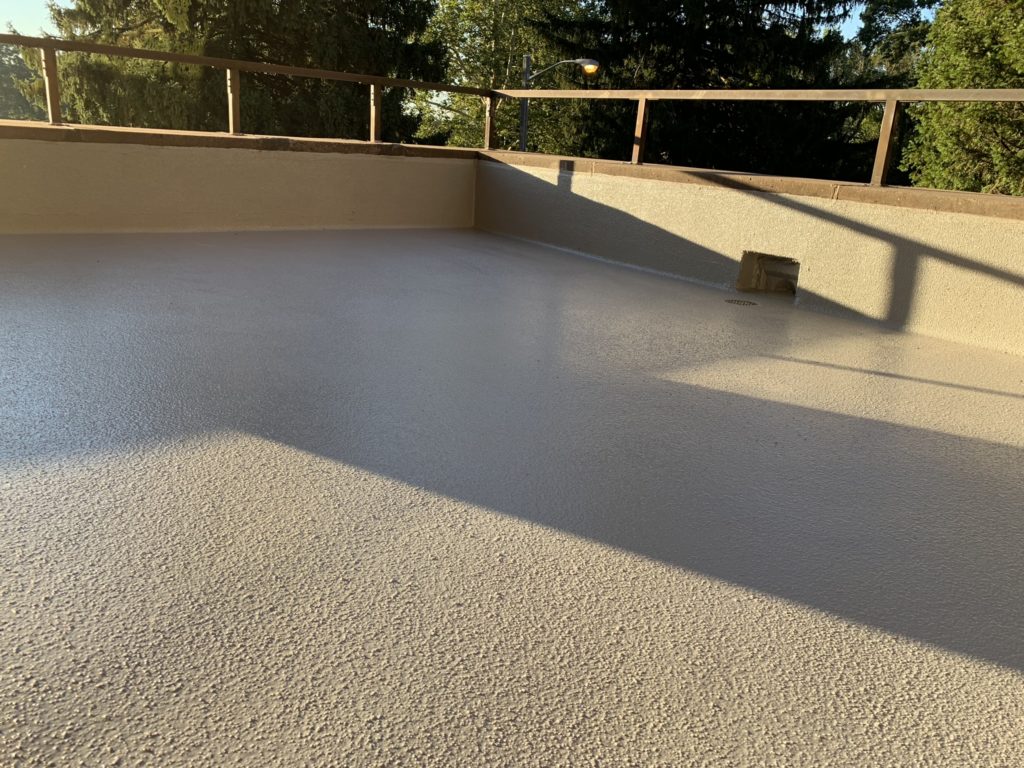
Membranes almost never fail in the middle. They fail at the sill pan, the wall turn-up, the rail post penetrations and the outer edge where there is no drip. A crew that can detail those five places properly, and show a property manager photos proving it, is selling something different from a price per square foot.
ArmorThane has a solid write-up on the technical side of this if you want to get fluent before your first walk-through. Their balcony waterproofing guide covers the systems, the mil ranges and the sill and edge details, and includes a slope and sill calculator you can run on your phone while you are standing on the deck.
Learn those details. The inspection reports are going to keep coming.