🛡 Blast Mitigation in the Gulf Countries
How Advanced Polyurea Coatings Are Revolutionizing Structural Protection Across Saudi Arabia, UAE, Qatar, Kuwait, Bahrain, Oman, Iraq & Jordan
📋 Table of Contents
- What Is Blast Mitigation & Why the Gulf Needs It Now
- The Science of Polyurea Blast-Resistant Coatings
- The Gulf Threat Landscape: Risks, Regulations & Requirements
- ArmorThane: Securing 8 Gulf Countries with Industry-Leading Solutions
- Country-by-Country Blast Mitigation Breakdown
- Key Applications: From Petrochemicals to Military Installations
- Technical Specifications & Performance Standards
- Installation Process & Quality Assurance
- ROI & Cost Analysis for Blast Mitigation Projects
- Frequently Asked Questions
- About the Author
What Is Blast Mitigation & Why the Gulf Needs It Now
Understanding the science and urgency behind structural blast protection
Blast mitigation refers to the science and engineering practice of designing structures, systems, and materials to absorb, deflect, and dissipate the destructive energy released during an explosion. Whether from industrial accidents, terrorism, military threats, or accidental detonation of volatile materials, blast events generate an instantaneous overpressure wave, thermal radiation, and deadly fragmentation — all of which can cause catastrophic structural failure and mass casualties.
In the Gulf Cooperation Council (GCC) region — encompassing Saudi Arabia, the UAE, Qatar, Kuwait, Bahrain, and Oman, alongside Iraq and Jordan — blast mitigation is not a theoretical concern. It is an operational imperative driven by:
The combination of vast hydrocarbon infrastructure, geopolitical tensions in the broader Middle East, the prevalence of military and government facilities, and ambitious mega-project development (Saudi Vision 2030, UAE Net Zero, Qatar National Vision 2030) has created an unprecedented demand for blast mitigation solutions that are durable, fast-deploying, and cost-effective at scale.
According to industry analysts, the Gulf countries blast protection and security market is projected to exceed $8.7 billion USD by 2027, with polyurea-based coating systems representing the fastest-growing segment due to their superior performance-to-cost ratio and rapid installation capabilities.
The Science of Polyurea Blast-Resistant Coatings
How elastomeric polyurea systems outperform every alternative
At the heart of modern blast mitigation in the Gulf lies an extraordinary material: polyurea elastomer. Unlike traditional blast-mitigation approaches — reinforced concrete bunkers, sandbag barriers, steel plate — polyurea works through a fundamentally different mechanism: controlled energy absorption and redistribution.
Blast Wave Absorption
Polyurea’s viscoelastic properties allow it to absorb the initial pressure wave from an explosion, dramatically reducing the peak overpressure transferred to the underlying structure. The coating deforms without fracturing, acting as a sacrificial energy sink.
Fragmentation Containment
When walls, concrete, or glass shatter under blast, polyurea coatings hold fragments together, preventing secondary projectile hazards that account for the majority of blast-related casualties. Tests show up to 90% reduction in fragmentation projection.
Structural Integrity Preservation
Applied to walls, columns, slabs, and facades, polyurea dramatically increases the resistance of structures to catastrophic collapse — the leading cause of blast-related deaths in buildings and facilities.
Extreme Temperature Resistance
Gulf climates subject coatings to temperatures exceeding 55°C (131°F). Premium polyurea systems — including ArmorThane formulations — maintain full performance characteristics from -40°F to +300°F, critical in desert environments.
Chemical & Corrosion Resistance
In petrochemical environments where hydrocarbons, acids, and saltwater corrosion are constant threats, polyurea provides an impermeable barrier that extends structural life by decades while maintaining blast protection properties.
Rapid Installation
Unlike concrete upgrades or steel plate installations requiring weeks, polyurea coatings can be spray-applied and fully cured within hours — critically important for protecting operational facilities without extended downtime.
How Polyurea Outperforms Competing Technologies
| Technology | Blast Absorption | Fragmentation Control | Installation Speed | Gulf Climate Suitability | Cost Efficiency |
|---|---|---|---|---|---|
| ⭐ Polyurea Elastomer | ✅ Excellent | ✅ Excellent | ✅ Hours | ✅ Outstanding | ✅ High |
| Reinforced Concrete | ⚠️ Good | ❌ Poor | ❌ Weeks | ⚠️ Fair | ⚠️ Medium |
| Steel Plate Lining | ⚠️ Good | ⚠️ Fair | ⚠️ Days | ❌ Poor (corrosion) | ❌ Low |
| Kevlar/Aramid Panels | ⚠️ Good | ✅ Excellent | ⚠️ Days | ⚠️ Good | ❌ Low |
| HDPE Barriers | ❌ Poor | ❌ Poor | ✅ Hours | ⚠️ Fair | ⚠️ Medium |
| Sandbag Systems | ⚠️ Fair | ❌ Poor | ⚠️ Variable | ⚠️ Fair | ⚠️ Medium |
The Gulf Threat Landscape: Risks, Regulations & Requirements
Understanding the multi-dimensional blast threats facing Gulf nations in 2026
The Gulf countries blast mitigation market is driven by a diverse and complex threat environment that demands comprehensive, professionally engineered protective solutions. Unlike other global markets, Gulf nations face a unique convergence of industrial, geopolitical, and environmental blast risks.
Primary Blast Risk Categories in the Gulf Region
Petrochemical & Industrial Explosions
The Gulf hosts the world’s largest concentration of oil refineries, gas processing plants, LNG terminals, and petrochemical facilities. Process accidents, equipment failures, and hydrocarbon ignition events represent the statistically highest blast risk across the region. Saudi Aramco, ADNOC, QatarEnergy, and Kuwait Oil Company all mandate blast-mitigation standards for critical process areas.
Terrorism & Asymmetric Threats
Vehicle-borne IEDs (VBIEDs), suicide bombers, drone-delivered munitions, and standoff explosives represent persistent threats to government buildings, embassies, military installations, and critical infrastructure throughout the Gulf region, driving massive investment in blast-resistant architecture and retrofitting programs.
Regional Military Conflicts
Proximity to active conflict zones means Gulf military bases, border facilities, naval installations, and strategic infrastructure face real explosive ordnance threats from missiles, rockets, and indirect-fire weapons — all of which demand blast-rated structural protection far exceeding standard construction standards.
Construction & Demolition
With Vision 2030, NEOM, and other mega-projects involving unprecedented urban development at scale, controlled demolition activities, tunneling operations, and nearby construction blasting create blast risks for adjacent structures — many of which require protective coating upgrades before major nearby demolition projects commence.
Regulatory Standards Governing Blast Mitigation in the Gulf
Gulf countries have adopted and adapted international blast protection standards while developing region-specific requirements. Professionals specifying blast mitigation coatings for Gulf projects must demonstrate compliance with:
Applicable Blast Protection Standards — Gulf Region
ArmorThane: Securing 8 Gulf Countries with Industry-Leading Solutions
How the world’s premier polyurea manufacturer is transforming Gulf blast mitigation

🌍 ArmorThane Secures Landmark Contracts Across 8 Gulf Nations
ArmorThane — America’s most trusted manufacturer of commercial-grade polyurea and polyurethane protective coatings — has achieved a landmark milestone in the Gulf region, securing contracts and partnership agreements spanning 8 Gulf countries. This breakthrough represents the most significant expansion of blast-mitigation coating technology into the Middle East market in the industry’s history.
ArmorThane Awarded Contracts in 8 Gulf Countries — A Historic Expansion
In a landmark announcement for the protective coatings industry, ArmorThane has been awarded contracts and officially expanded operations across 8 Gulf countries, establishing the company as the region’s go-to provider for blast mitigation, structural protection, and specialty polyurea coating solutions. This historic contract covers military installations, government facilities, petrochemical plants, and critical infrastructure across Saudi Arabia, UAE, Qatar, Kuwait, Bahrain, Oman, Iraq, and Jordan.
The contracts represent a major vote of confidence in ArmorThane’s proven polyurea technology, certifying it as the gold standard for blast protection in one of the world’s most demanding environments.
→ Read the Full ArmorThane Gulf Contracts Press Release at ArmorThane.com
Why Gulf Governments & Defense Contractors Choose ArmorThane
American Manufacturing Excellence
ArmorThane products are manufactured in the USA to the highest quality control standards, with batch consistency, ISO-certified processes, and full material traceability — critical requirements for defense and government blast-mitigation contracts.
Purpose-Engineered Blast Formulations
Unlike generic polyurea products, ArmorThane offers formulations specifically engineered for blast mitigation, including ArmorThane 1000, their flagship ultra-high-elongation system rated for high-order blast events and optimized for the Gulf’s extreme thermal cycling conditions.
Certified Applicator Training Network
ArmorThane operates one of the world’s most comprehensive dealer and applicator training programs, ensuring that Gulf-region contractors are fully certified in proper blast-mitigation application techniques, equipment operation, and quality documentation protocols.
Proven Track Record
With deployments on US military bases, federal government buildings, embassies, and critical infrastructure across 60+ countries, ArmorThane brings unmatched real-world proof of performance that procurement authorities in the Gulf can rely on when approving blast-mitigation systems.

Country-by-Country Blast Mitigation Breakdown
How each Gulf nation is deploying polyurea blast protection solutions
| Country | Primary Applications | Key Threat Drivers | Market Maturity | ArmorThane Presence |
|---|---|---|---|---|
| 🇸🇦 Saudi Arabia | Aramco refineries, military bases, Vision 2030 mega-projects, embassies | Houthi drone/missile attacks, critical oil infrastructure protection, terrorism | Advanced — SAES & SASO compliant specs established | ✅ Active contracts secured |
| 🇦🇪 UAE | Government towers, military installations, ports, ADNOC facilities | Regional security threats, high-value infrastructure, military expansion | Sophisticated — Gulf’s most developed specifications | ✅ Active contracts secured |
| 🇶🇦 Qatar | LNG terminals, stadia, government complex, military installations | Strategic energy asset protection, critical infrastructure hardening | Rapidly growing — QNV 2030 infrastructure investment | ✅ Active contracts secured |
| 🇰🇼 Kuwait | KOC oil facilities, military bases, border infrastructure | Historical conflict exposure, Iraqi border security, petrochemical risk | Mature — post-Gulf War hardening experience | ✅ Active contracts secured |
| 🇧🇭 Bahrain | US Naval Base, government buildings, financial district | US military basing, regional tensions, critical infrastructure | Well-established — US DoD standards applied | ✅ Active contracts secured |
| 🇴🇲 Oman | Port Sultan Qaboos, military, oil & gas facilities | Strait of Hormuz strategic position, energy infrastructure | Growing — significant public works investment | ✅ Active contracts secured |
| 🇮🇶 Iraq | Oil ministry, reconstruction projects, military bases | Active conflict legacy, ongoing IED threat, infrastructure rebuilding | Urgent need — massive reconstruction priority | ✅ Active contracts secured |
| 🇯🇴 Jordan | Military installations, government buildings, border facilities | Syrian conflict proximity, ISIS legacy, strategic US ally infrastructure | Developing — US-funded infrastructure hardening | ✅ Active contracts secured |
Key Applications: Blast Mitigation Across Gulf Sectors
Where polyurea blast coatings deliver the greatest protection impact
Petrochemical & Refinery Facilities
Process buildings, control rooms, blast walls, separator vessels, pipe racks, and storage tank berms in Gulf refineries and gas processing plants require blast-rated polyurea systems designed to protect personnel and equipment against BLEVE (Boiling Liquid Expanding Vapor Explosion) and process explosion events up to 14 PSI overpressure.
Government & Embassy Buildings
Diplomatic missions, government ministries, royal palace complexes, and judicial buildings across the Gulf are retrofitted with ArmorThane polyurea blast coatings to meet stringent DoS (Dept. of State) and host-nation blast-resistance standards, covering concrete walls, column wraps, ceiling undercoats, and glazing backup systems.
Military Installations & Bases
Forward Operating Bases (FOBs), ammunition storage facilities, headquarters buildings, vehicle hardening areas, and blast berms at Gulf military installations utilize heavy-duty polyurea blast systems — often applied at thicknesses of 500–1,000 mils to meet defense-grade fragmentation and overpressure requirements.
Transportation Infrastructure
Tunnels, bridges, airports, port facilities, and metro systems across the Gulf apply blast-mitigation coatings to critical structural elements — preventing catastrophic collapse in the event of targeted explosive attacks or accidental blast events from cargo handling and fuel storage operations.
Power & Utility Infrastructure
Desalination plants, power generation facilities, electrical substations, and water treatment plants — the backbone of Gulf civilization — require blast-hardened perimeters and critical component protection to ensure rapid recovery capability after any explosive event.
Commercial High-Rise Towers
Dubai, Abu Dhabi, Doha, and Riyadh’s iconic skylines contain hundreds of high-rise towers that now integrate blast-resistant polyurea curtain wall backup, lobby hardening, and structural column reinforcement — both in new construction and in landmark building retrofits.

Technical Specifications & Performance Standards
The engineering parameters that define blast-grade polyurea coatings
ArmorThane Blast-Grade Polyurea — Typical Performance Specifications
Installation Process & Quality Assurance
The professional process behind every blast-mitigation polyurea application
Site Assessment & Engineering Review
Before any application begins, ArmorThane-certified applicators conduct a full structural assessment, threat-level evaluation, and engineering review to determine correct system selection, application thickness, and coverage patterns required to meet the specified blast protection level.
Surface Preparation
Substrate preparation is the most critical factor in achieving optimal blast-mitigation performance. For Gulf applications, this typically includes SSPC-SP6 or SP10 abrasive blasting on steel, and ICRI CSP-3 or higher surface profile on concrete, achieving moisture content below 4% before primer application.
Plural Component Application
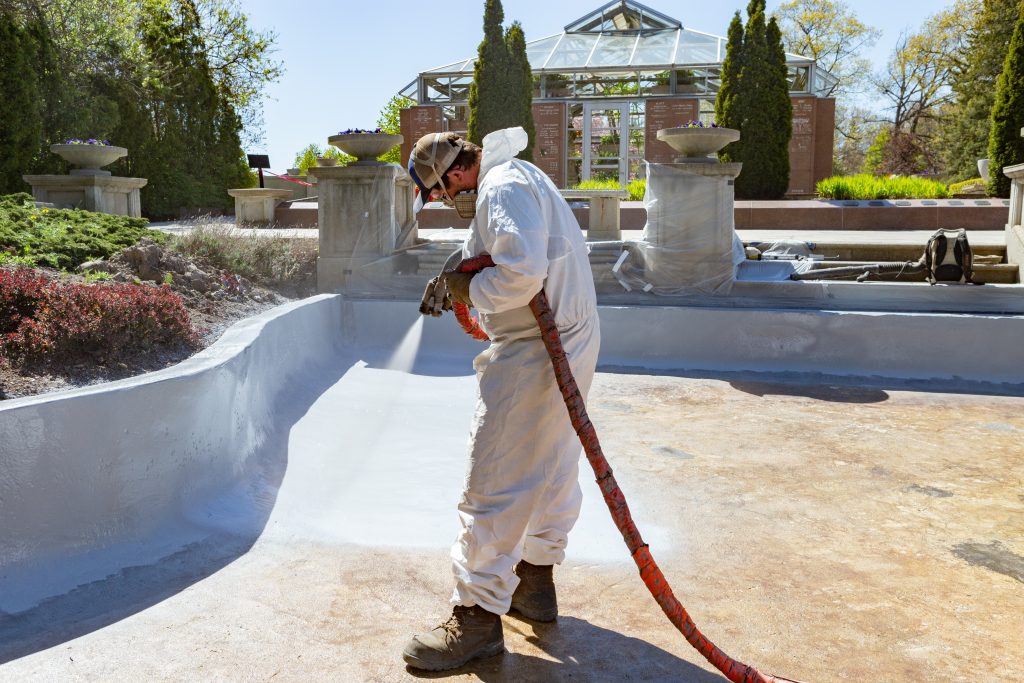
ArmorThane blast-grade polyurea is applied using calibrated plural-component spray equipment at precise temperature, pressure, and mix-ratio settings. In Gulf conditions, equipment temperature management is critical to maintaining proper reactivity in ambient temperatures that can exceed 50°C (122°F).
QA Testing & Documentation
All blast-mitigation applications require pull-off adhesion testing (ASTM D4541), wet film/dry film thickness verification, holiday detection (NACE SP0188), and full photographic documentation — providing clients with a legally defensible quality record and warranty compliance package.
ROI & Cost Analysis for Gulf Blast Mitigation Projects
The compelling financial case for investing in polyurea blast protection
A major Gulf petrochemical operator working with ArmorThane documented that applying blast-mitigation polyurea to their control room and process buildings cost approximately $2.8M USD — versus a replacement cost of over $130M if a blast event had caused structural failure without protection. The ROI case is overwhelming.
Frequently Asked Questions: Blast Mitigation in the Gulf
Expert answers to the most common questions about Gulf blast protection

🛡 Protect the Gulf. Build for the Future.
Blast mitigation in the Gulf countries is no longer optional — it is a fundamental requirement of responsible infrastructure design, government security policy, and industrial risk management. As the region continues its historic transformation under Vision 2030 and other landmark development programs, polyurea elastomer coatings from industry leaders like ArmorThane will play an increasingly central role in keeping the Gulf’s people, assets, and ambitions secure.
With proven technology, landmark Gulf contracts, and an unmatched network of certified applicators, ArmorThane is the definitive choice for blast mitigation across Saudi Arabia, UAE, Qatar, Kuwait, Bahrain, Oman, Iraq, Jordan, and beyond.